There are many different paths you can take to prepare a document for publication. At Prepress Projects, one of the services we offer is copy-editing. If you have a piece of writing where the ideas are conceptually sound but you’re worried that the writing isn’t reader-friendly, or you want a team of native English speakers to refine syntax or check grammar and spelling, having the work copy-edited is the best way to elevate your writing.
Copy-editing is usually the intermediate stage of editing, focused on improving a piece of writing after the content has largely been set. ‘Copy’ in this context is text that is to be published but is not in its final layout. This editing stage is usually focused on taking that copy text and polishing and fine-tuning it, not on deciding on big-picture elements such as what content to include or in what order ideas should be introduced. Instead, we’re focusing on taking the words and ideas that are there and presenting them in the most readable, understandable way.
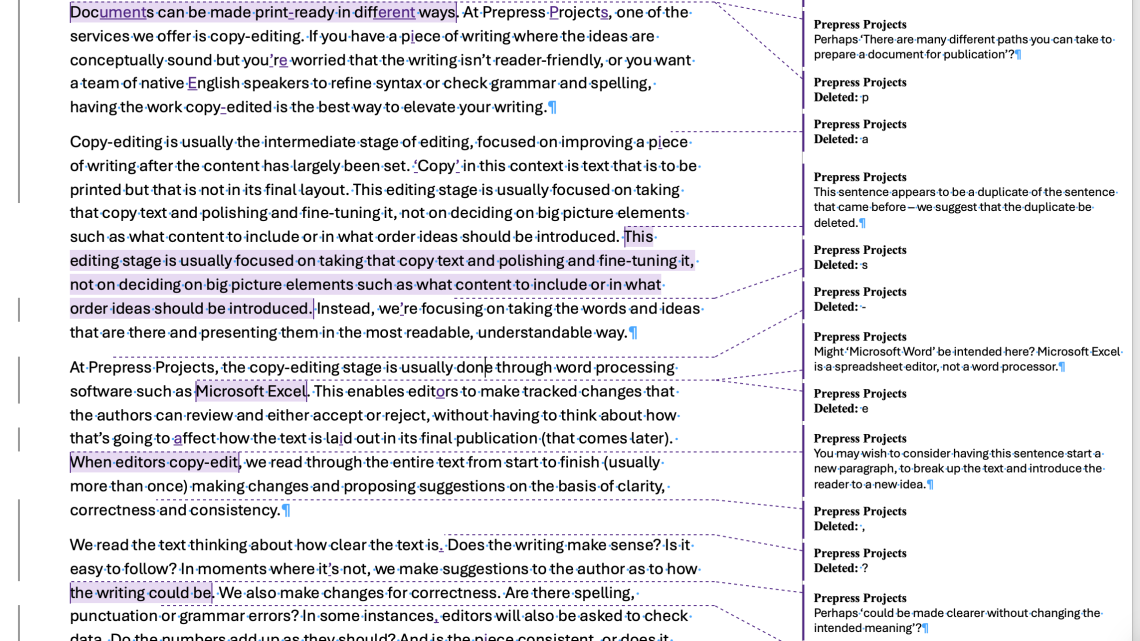
At Prepress Projects, the copy-editing stage is usually done through word processing software such as Microsoft Word. This enables editors to make tracked changes that the authors can review and either accept or reject, without having to think about how that’s going to affect how the text is laid out in its final publication (that comes later).
When editors copy-edit, we read through the entire text from start to finish (usually more than once), making changes and proposing suggestions on the basis of clarity, correctness and consistency.
We read the text thinking about how clear the text is. Does the writing make sense? Is it easy to follow? In moments where it’s not, we make suggestions to the author as to how the writing could be made clearer without changing the intended meaning. We also make changes for correctness. Are there spelling, punctuation or grammar errors? We will find and fix them. In some instances, editors will also be asked to check data. Do the numbers add up as they should? And is the piece consistent, or does it contradict itself? We flag any issues and inconsistencies with the authors, drawing your attention to these elements and letting you, the subject matter expert, have the final say in any changes.
Editors will also frequently be asked to make sure that the piece of writing adheres to a house style, often set by the publisher. This includes elements such as whether UK spelling or US spelling is used throughout, whether quotes are set in double or single quotation marks, and whether titles are written in sentence case or title case. We work hard to make sure that the piece of writing is consistent not only internally but also with the spelling and grammar conventions used for all writing published by that organisation. The final edit should be a piece that is comprehensible, correct and consistent.
So why should you work with a professional editing service? Professional copy-editing ensures that an entire document, even a piece written by multiple authors, has a coherent voice. It ensures that a piece makes sense on a deeper level and that a reader will be able to understand complex ideas at first read. It ensures that writing by non-native-English writers reads fluently. And, in an age when computerised editing tools and large-scale language models are deployed haphazardly to ‘fix’ writing – making changes based on probability, not specificity – professional editing ensures that changes are suited to the needs of your particular piece of writing and made with a level of credibility and accountability that digital tools cannot guarantee.
Editorial intervention is never about taking away an author’s voice or stripping a piece of writing of what makes it unique – your words are important and should shine through the whole process. Instead, editorial intervention refines, elevates and polishes, helping you say what you mean in the best way that you can.